

Voice Bots: The Future of Customer Engagement in Indian Enterprises

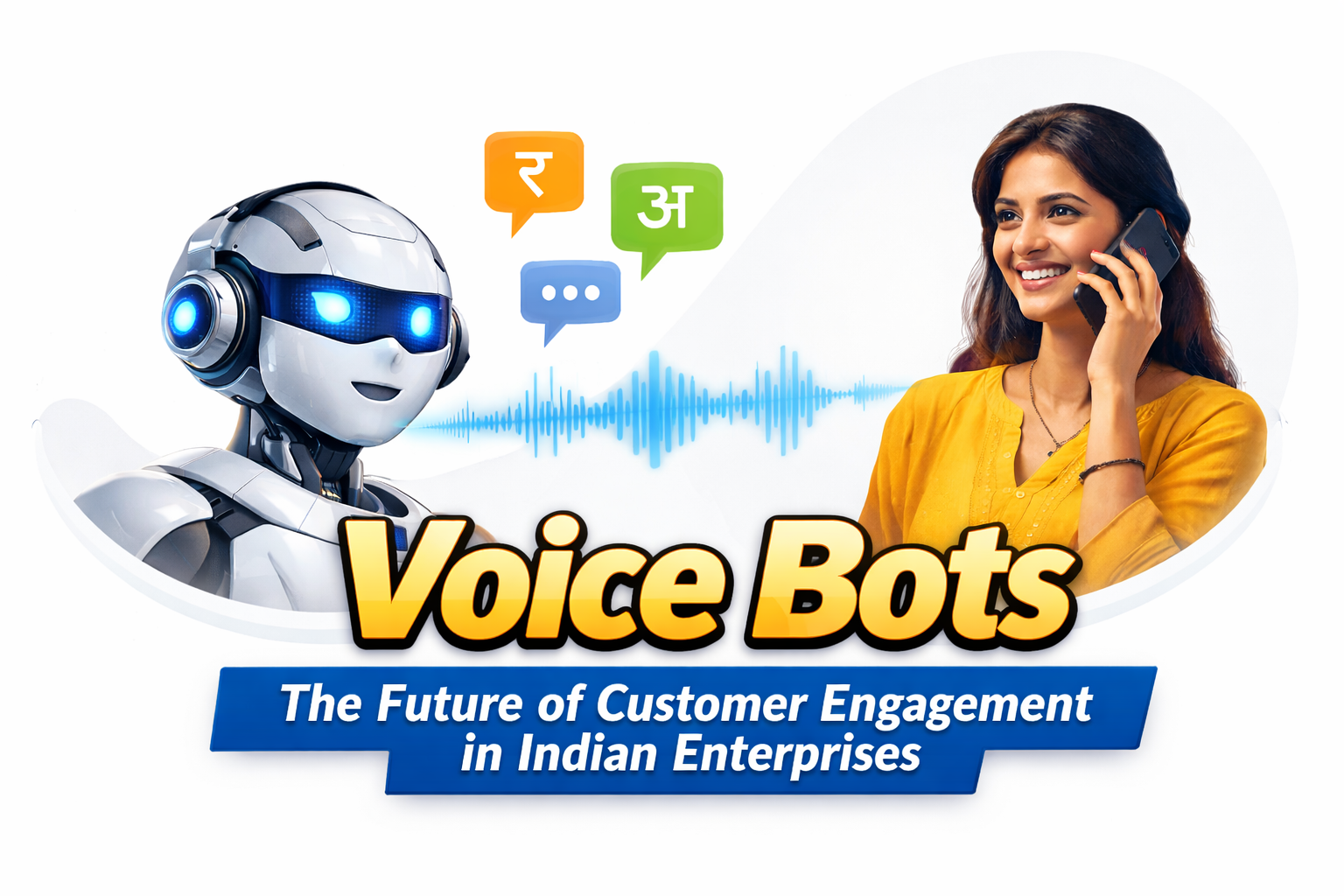

Voice Bots: The Future of Customer Engagement in Indian Enterprises
The Indian customer service landscape is undergoing a seismic shift. Traditional call centers, once the backbone of customer engagement, are giving way to intelligent voice bots that understand context, speak multiple languages mid-conversation, and resolve queries with unprecedented accuracy. As enterprises grapple with rising operational costs and customer expectations that demand 24/7 availability, voice bots have emerged not just as a cost-cutting tool but as a strategic imperative for businesses seeking competitive advantage.
The evolution from basic interactive voice response systems to sophisticated voice bots represents more than technological progress—it signals a fundamental reimagining of how businesses interact with customers. Today's voice bots don't just respond to commands; they understand intent, detect emotion, and adapt their responses in real-time. For Indian enterprises operating in multilingual markets with code-mixed conversations being the norm rather than the exception, this transformation carries particular significance.
The Journey from IVR to Intelligent Voice Bots
The story of voice technology in customer service began with Interactive Voice Response systems in the 1960s. These early systems, primitive by today's standards, could only recognize touch-tone inputs. Customers navigated through rigid menu structures, pressing numbers to reach the right department—a process that often felt more like solving a maze than receiving service.
The 1990s brought speech recognition capabilities, allowing customers to speak their responses instead of pressing buttons. Yet these systems remained frustratingly limited. They could recognize only specific keywords, struggled with accents, and failed completely when customers deviated from expected phrases. For Indian businesses serving diverse linguistic populations, these limitations proved particularly challenging.
The 2010s marked the beginning of the AI revolution in voice technology. Machine learning algorithms enabled systems to understand natural language with increasing accuracy. Cloud computing made sophisticated voice processing accessible to businesses of all sizes. Suddenly, the technology that powered voice assistants in smartphones became available for enterprise customer service.
Today's voice bots represent the culmination of decades of innovation. They leverage advanced natural language processing, sentiment analysis, and contextual understanding to deliver conversations that feel genuinely human. These systems can handle complex queries, switch seamlessly between languages, and even detect customer frustration to escalate calls when necessary.
Understanding Modern Voice Bot Architecture
A sophisticated voice bot operates through multiple interconnected layers, each performing specialized functions. The architecture begins with automatic speech recognition, the component that converts spoken words into text. For Indian enterprises, this layer must handle unique challenges—heavy accents, background noise common in telephony environments, and code-mixed speech where customers blend English with regional languages mid-sentence.
The natural language understanding layer interprets the meaning behind transcribed text. This goes beyond simple keyword matching to grasp intent, context, and sentiment. When a customer says "mera bill bahut zyada aa raha hai," the system must understand not just the complaint about a high bill, but the underlying frustration and the need for both explanation and resolution.
Dialog management orchestrates the conversation flow. This component determines how the bot should respond based on conversation history, customer profile, and business rules. It decides when to ask clarifying questions, when to provide information, and when to escalate to human agents.
The text-to-speech synthesis layer converts the bot's responses back into natural-sounding speech. Modern systems generate voices with appropriate emotional tone, speaking naturally rather than in the robotic monotone of earlier technologies. For multilingual markets, this layer must produce authentic-sounding speech across multiple languages, maintaining consistent voice characteristics even when switching languages.
Backend integrations connect the voice bot to business systems CRM platforms, payment gateways, inventory databases, and ticketing systems. These connections enable the bot to perform actual transactions, not just provide information. A customer can check account balances, schedule appointments, make payments, or update personal information, all through voice interaction.
The Indian Context: Unique Challenges and Opportunities
India presents a unique environment for voice bot deployment, characterized by linguistic diversity unmatched anywhere in the world. A single customer conversation might flow from English to Hindi to a regional language and back, sometimes within a single sentence. Traditional voice bots trained primarily on single-language datasets struggle with this reality.
Accent variation adds another layer of complexity. The English spoken in Mumbai differs markedly from that in Chennai or Kolkata. Regional language variations multiply this challenge Malayalam spoken in Thrissur differs from that in Thiruvananthapuram. Voice bots serving Indian markets must handle this variation without compromising accuracy.
Telephony environments introduce technical challenges. Mobile network quality varies significantly across geographies. Background noise from busy streets, family conversations, or workplace chatter often accompanies customer calls. Voice bots must extract clear speech signals from these noisy inputs while maintaining conversation quality.
Cultural expectations around conversation styles differ from Western norms. Indian customers often provide context-rich narratives rather than direct queries. A customer might begin by explaining their entire situation before stating their actual need. Voice bots must process these longer, more contextual conversations without losing patience or accuracy.
Yet these challenges create opportunities for businesses that deploy voice bots effectively. The sheer scale of India's customer base means that even modest efficiency improvements translate to significant cost savings. The growing comfort with voice assistants in personal devices has created customer receptiveness to voice-based service channels. The chronic shortage of skilled customer service agents makes automation not just cost-effective but operationally necessary.
Voice Bots Across Industries: Real-World Applications
Banking and financial services have emerged as early adopters of voice bot technology. Customers use voice bots to check account balances, transfer funds, request statements, and resolve common queries about credit cards or loans. The 24/7 availability particularly benefits customers who work during traditional banking hours and need service after business closes.
In collections, voice bots have transformed debt recovery operations. Rather than expensive outbound calling campaigns staffed by human agents, voice bots conduct initial outreach, send payment reminders, and handle routine follow-ups. When customers commit to payment, bots immediately generate payment links and confirm transactions. This approach has demonstrated first call resolution rates exceeding 80 percent while reducing collection costs by over 70 percent.
Insurance companies deploy voice bots for policy servicing, claims status updates, and premium payment reminders. The technology proves particularly valuable during claim intimation, where stressed customers need immediate acknowledgment and clear guidance on next steps. Voice bots provide this immediate response while capturing necessary claim details for processing.
Automotive businesses use voice bots for service appointment scheduling, test drive bookings, and service reminders. When a customer's vehicle is due for maintenance, the voice bot proactively calls to offer convenient appointment slots. The bot accesses service records to recommend appropriate maintenance based on vehicle age and usage patterns.
Consumer durable companies leverage voice bots for warranty registration, service requests, and troubleshooting guidance. When customers report product issues, bots can walk them through basic troubleshooting steps before scheduling technician visits. This reduces unnecessary service calls while ensuring genuine issues receive prompt attention.
Telecom operators deploy voice bots to handle the massive volume of recharge requests, plan inquiries, and network issue complaints. Given the price sensitivity of this sector and the enormous customer base, voice automation delivers substantial cost savings while maintaining service quality.
Real estate firms use voice bots for lead qualification and site visit scheduling. When potential buyers express interest in properties, bots engage them in qualification conversations, understand their requirements, and schedule visits with sales teams. This ensures sales agents spend time with genuinely interested, pre-qualified leads.
Healthcare organizations implement voice bots for appointment scheduling, prescription refill reminders, and post-treatment follow-ups. In a sector where phone lines often stay busy and appointment scheduling creates administrative burden, voice automation improves both patient experience and operational efficiency.
The Technology Behind Effective Voice Bots
Speech recognition accuracy determines voice bot effectiveness. Modern systems use deep neural networks trained on vast datasets representing diverse accents, speaking styles, and acoustic conditions. For Indian markets, effective training requires datasets capturing regional variations, code-mixing patterns, and telephony-specific acoustic properties.
Sentiment analysis capabilities enable voice bots to detect customer emotions from tone, pace, and word choice. When a customer sounds frustrated or angry, the bot can adjust its response style, offer immediate escalation to human agents, or provide empathetic acknowledgment before proceeding with resolution. This emotional intelligence transforms transactional interactions into experiences that customers perceive as genuinely helpful.
Intent recognition moves beyond literal interpretation to understand what customers actually want. When someone says "I can't access my account," the intent might be password reset, account unlock, or technical support. The bot must recognize the true intent from context clues and previous conversation to provide relevant assistance.
Multi-turn conversation management allows voice bots to handle complex interactions requiring multiple exchanges. Rather than limiting customers to single-query interactions, sophisticated bots maintain conversation context across turns. They remember what was discussed earlier, reference previous statements, and build toward comprehensive resolutions.
Latency optimization ensures conversations feel natural. Humans expect responses within milliseconds during conversation. Voice bots must process speech, understand intent, generate responses, and synthesize speech in under 500 milliseconds to maintain conversational flow. Achieving this requires optimized models and efficient infrastructure.
Voice biometrics add security for sensitive transactions. Rather than asking customers to provide passwords or security codes, voice bots can verify identity from voice characteristics. This passive authentication improves both security and user experience.
Measuring Voice Bot Success: Key Performance Indicators
First call resolution represents the percentage of customer queries resolved without escalation or callback. High FCR indicates the voice bot handles a wide range of scenarios effectively. Leading implementations achieve FCR rates above 80 percent, dramatically reducing the workload on human agents.
Containment rate measures what percentage of interactions the voice bot completes without transferring to human agents. While not all transfers indicate failure—some queries genuinely require human judgment high containment rates demonstrate the bot handles its designed scope effectively.
Average handling time tracks how long interactions take from greeting to resolution. Effective voice bots resolve queries faster than human agents for routine matters, though complex issues may require longer interactions. Monitoring this metric helps identify opportunities for conversation flow optimization.
Customer satisfaction scores reveal how customers perceive their voice bot interactions. Post-interaction surveys capture this feedback. While voice bots may score slightly lower than human agents initially, well-designed systems achieve satisfaction ratings comparable to human interactions.
Recognition accuracy measures how often the voice bot correctly understands customer speech. Accuracy above 90 percent is essential for acceptable user experience. For Indian markets handling code-mixed conversations, achieving this accuracy requires specialized training and models.
Cost per interaction quantifies the financial impact of voice bot deployment. By comparing the cost of voice bot interactions to human-handled calls, businesses calculate return on investment. Typical deployments reduce interaction costs by 60 to 80 percent.
How Inya Workforce Transforms Voice Bot Deployment
Traditional voice bot implementation requires extensive technical expertise, lengthy development cycles, and ongoing maintenance resources. Enterprises face challenges integrating disparate technologies speech recognition, natural language processing, dialog management, and backend systems. The complexity creates barriers to adoption, particularly for organizations without dedicated AI teams.
Inya Workforce addresses these challenges through a unified agentic AI platform specifically designed for enterprise voice automation. Rather than assembling components from multiple vendors, organizations deploy pre-built AI agents configured for specific use cases. These agents understand industry-specific terminology, follow regulatory requirements, and integrate seamlessly with existing business systems.
The platform's proprietary speech recognition technology achieves accuracy rates 30 percent higher than generic alternatives for Indian accents and telephony environments. This improvement directly translates to better customer experiences and higher containment rates. The system handles code-mixed conversations natively, understanding when customers switch between languages and responding appropriately.
Emotionally expressive text-to-speech generates voices that sound natural and appropriate to conversation context. Rather than mechanical monotone, customers hear responses that match the tone and urgency of their situation. This naturalness increases customer acceptance and reduces the perception of interacting with a machine.
Small language models deliver 90 percent of large language model performance in packages 100 times smaller. This efficiency enables rapid response times under 500 milliseconds latency essential for natural conversation flow. Smaller models also reduce infrastructure costs and simplify deployment.
Pre-built agents for collections, compliance, service booking, and lead engagement allow rapid deployment. Rather than building voice bots from scratch, organizations configure these agents for their specific requirements. Victor handles collections with empathetic approaches that improve recovery rates. Eva manages compliance queries with responses grounded in regulatory frameworks. Neo coordinates service appointments across customer preferences and technician availability. These agents begin delivering value within weeks rather than months.
Multi-LLM orchestration optimizes cost and performance by routing queries to appropriate language models. Simple factual queries go to efficient small models. Complex reasoning tasks leverage larger models. This intelligent routing maintains response quality while controlling computational costs.
The platform serves diverse sectors including banking, insurance, automotive, and consumer durables. Organizations from India's second-largest life insurer to major financial institutions rely on Inya Workforce for customer engagement. These deployments demonstrate the platform's ability to handle mission-critical workloads in regulated industries where reliability and compliance are non-negotiable.
Implementation Best Practices for Voice Bot Success
Successful voice bot deployment begins with clear scope definition. Organizations must identify specific use cases where voice automation delivers value without attempting to automate everything simultaneously. Starting with high-volume, routine queries allows teams to gain experience and demonstrate value before expanding to complex scenarios.
Conversation design requires understanding how customers actually speak, not how businesses wish they would speak. Recording and analyzing human agent calls reveals common phrasings, typical query patterns, and conversation flows. Voice bots should accommodate natural speech variations rather than forcing customers into rigid dialog structures.
Training data quality determines recognition accuracy. Voice bots need training on recordings that match their actual operating environment—telephony audio rather than studio recordings, real customer conversations rather than scripted readings. For Indian deployments, training data must represent the linguistic diversity and code-mixing patterns the bot will encounter.
Escalation paths ensure complex queries receive appropriate handling. Voice bots should recognize when they've reached their capability limits and transfer customers smoothly to human agents. These transfers should include conversation history so customers don't repeat themselves. Well-designed escalation maintains customer satisfaction even when the bot cannot fully resolve queries.
Continuous monitoring identifies improvement opportunities. Analyzing interactions where customers expressed frustration, where recognition failed, or where conversations led to dead ends reveals areas requiring refinement. Regular updates incorporating these learnings steadily improve performance.
Human agent collaboration positions voice bots as tools that augment rather than replace people. Agents handle escalated queries, review bot transcripts to identify training needs, and focus on complex scenarios requiring judgment. This collaboration creates better outcomes than either automation or human-only approaches alone.
Regulatory compliance requires particular attention in sectors like banking and insurance. Voice bots must follow disclosure requirements, obtain proper consents, and handle sensitive information securely. Regular compliance audits ensure ongoing adherence as regulations evolve.
The Future of Voice Bot Technology
Multimodal interactions will extend beyond voice alone. Future voice bots will seamlessly incorporate visual elements during calls, sending images, documents, or interactive screens to customer devices while maintaining voice conversation. This combination leverages the convenience of voice with the clarity of visual information.
Proactive engagement will shift voice bots from reactive response to anticipatory service. Rather than waiting for customers to call with issues, voice bots will predict needs and initiate helpful conversations. When systems detect potential problems an unusually high utility bill, suspicious account activity, upcoming contract expiration voice bots will proactively reach out with relevant information and solutions.
Hyper-personalization will tailor every interaction to individual customer preferences and history. Voice bots will remember past interactions, understand customer preferences, and adapt their approach accordingly. Some customers prefer brief, efficient interactions. Others want detailed explanations. Voice bots will recognize and accommodate these individual styles.
Emotional AI will advance beyond basic sentiment detection to nuanced emotional understanding. Future voice bots will recognize subtle emotional cues and respond with appropriate empathy. They'll detect when customers need reassurance, when they're confused and need clearer explanation, or when they're satisfied and ready to conclude.
Voice-to-voice AI will eliminate the intermediate text conversion step, processing speech directly to generate speech responses. This advancement will reduce latency further while capturing nuances that text conversion loses. Natural conversation flow will improve as systems process the full richness of human speech.
Industry-specific optimization will create voice bots deeply specialized for particular sectors. Rather than general-purpose systems adapted for each industry, organizations will deploy voice bots trained specifically on their domain's terminology, regulatory requirements, and customer needs. This specialization will improve both accuracy and relevance.
Building the Business Case for Voice Bot Investment
Cost reduction provides the most straightforward justification for voice bot investment. Human-handled customer service calls cost between 200 and 500 rupees depending on complexity and industry. Voice bot interactions cost 10 to 50 rupees. For organizations handling millions of annual interactions, these savings reach crores within the first year.
Scalability addresses the challenge of demand fluctuations. Traditional call centers require hiring and training agents months before anticipated volume increases. Voice bots scale instantly, handling thousands of simultaneous conversations without additional cost. This scalability proves particularly valuable for businesses with seasonal peaks or marketing campaigns that drive call volume spikes.
24/7 availability meets customer expectations for always-on service. Younger customers particularly expect to resolve issues on their schedule, not during traditional business hours. Voice bots provide this round-the-clock availability without the cost premiums associated with night shifts and weekend staffing.
Consistency ensures every customer receives accurate, policy-compliant responses. Human agents, despite training, naturally vary in knowledge and approach. Some provide excellent service while others fall short. Voice bots deliver consistent quality across every interaction, eliminating the variation that frustrates customers and creates compliance risks.
Speed advantages become apparent in routine transactions. Voice bots complete account balance inquiries, appointment scheduling, or payment processing in under two minutes. Human agents handling the same transactions take three to five minutes due to system navigation time, typing speed, and conversation pacing. This speed improvement enhances customer satisfaction while increasing throughput.
Data capture provides valuable insights often lost in traditional calls. Voice bots automatically log every interaction, capturing structured data about customer needs, conversation outcomes, and sentiment. This data reveals patterns that inform product development, identify training needs, and highlight emerging issues before they become widespread problems.
Preparing Your Organization for Voice Bot Success
Executive sponsorship proves essential for successful voice bot deployment. Leaders must communicate the strategic importance of automation, allocate necessary resources, and support the organizational changes that effective implementation requires. Without visible executive commitment, voice bot initiatives risk remaining isolated pilot projects rather than transformative programs.
Cross-functional collaboration brings together technology teams, customer service leaders, compliance officers, and business stakeholders. Voice bots impact multiple departments, and successful deployment requires input from each perspective. Regular coordination ensures the solution serves business needs while meeting technical and regulatory requirements.
Change management addresses the human dimension of automation. Customer service agents may worry about job security when voice bots enter their domain. Transparent communication about how automation creates opportunities for agents to focus on complex, rewarding work rather than repetitive queries helps build support. Involving agents in conversation design and continuous improvement creates ownership rather than resistance.
Infrastructure readiness ensures systems can support voice bot operations. Organizations need reliable telephony integration, appropriate API connections to backend systems, and sufficient computational resources for speech processing. Addressing these technical prerequisites before deployment prevents delays and ensures smooth launches.
Pilot programs allow controlled testing before full-scale deployment. Starting with a specific use case or customer segment lets organizations refine approaches, identify unforeseen challenges, and demonstrate value. Successful pilots build confidence and inform broader rollout strategies.
Training programs prepare teams for new workflows. While voice bots reduce call volume, they create new responsibilities monitoring bot performance, handling escalated calls, and analyzing interaction data. Preparing teams for these evolved roles ensures they can fully leverage automation capabilities.
Sign Up Now to Transform Your Customer Engagement
Voice bots represent a fundamental shift in how enterprises engage with customers. The technology has matured beyond early limitations to deliver sophisticated, multilingual interactions that customers genuinely appreciate. For Indian businesses navigating linguistic diversity, rising costs, and evolving customer expectations, voice bots provide a path to sustainable competitive advantage.
The question facing business leaders is no longer whether to deploy voice bots, but how quickly they can implement them effectively. Organizations that move decisively will capture operational efficiencies, improve customer satisfaction, and establish market leadership. Those that delay risk competitive disadvantage as customers come to expect the speed and convenience that voice automation enables.
Inya Workforce accelerates this transformation through an integrated platform designed specifically for enterprise needs. Rather than navigating complex technology selection and integration, organizations deploy proven solutions configured for their industries and use cases. With deployment timelines measured in weeks and immediate cost reductions exceeding 70 percent, the business case is compelling.
Join the growing number of enterprises leveraging voice bot technology to redefine customer engagement. Book a demo to see how Inya Workforce can transform your customer service operations while reducing costs and improving satisfaction. The future of customer engagement is here—the only question is when you'll embrace it.
Frequently Asked Questions
What is a voice bot and how does it differ from IVR systems?
Voice bots use artificial intelligence to understand natural language and conduct human-like conversations, while IVR systems rely on pre-recorded menus and touch-tone inputs. Voice bots can interpret intent, handle variations in phrasing, and maintain context across multi-turn conversations. They understand when a customer says "I need help with my bill" or "my statement shows wrong charges" and recognize both express the same underlying need. IVR systems require customers to navigate menu hierarchies and speak specific keywords, creating frustration when requests don't fit predefined options.
How accurate are voice bots with Indian accents and regional languages?
Modern voice bots specifically trained for Indian markets achieve accuracy rates above 90 percent for both Indian English accents and regional languages. Advanced systems like Inya Workforce achieve 30 percent higher accuracy than generic alternatives because they train on datasets representing India's linguistic diversity. These systems handle code-mixed conversations where customers switch between languages mid-sentence, a capability critical for Indian deployments. However, accuracy depends on training data quality and model sophistication generic voice recognition systems trained primarily on Western accents struggle with Indian speech patterns.
What is the typical implementation timeline for voice bot deployment?
Implementation timelines vary based on complexity and organizational readiness. Organizations using pre-built platforms like Inya Workforce deploy voice bots in four to eight weeks for standard use cases like collections, appointment scheduling, or service inquiries. Custom-built solutions require three to six months for design, development, training, and testing. The timeline includes conversation design, system integration, training data preparation, testing, and phased rollout. Organizations with clear requirements, prepared integration points, and dedicated teams complete deployments faster than those defining scope during implementation.
How do voice bots handle situations they cannot resolve?
Well-designed voice bots recognize their limitations and escalate to human agents when necessary. They detect indicators that escalation is needed—repeated misunderstandings, customer frustration expressed through tone or explicit statements, or queries outside their trained scope. During transfer, bots provide agents with conversation history so customers don't repeat themselves. The best implementations transfer smoothly, telling customers "I'm connecting you with a specialist who can help better with this specific situation." This graceful escalation maintains customer satisfaction even when the bot cannot fully resolve the query.
What cost savings can organizations expect from voice bot deployment?
Organizations typically reduce customer service costs by 60 to 80 percent for interactions handled by voice bots. Human-handled calls cost 200 to 500 rupees depending on complexity, while voice bot interactions cost 10 to 50 rupees. For organizations handling 100,000 monthly calls where 70 percent can be automated, annual savings reach 15 to 40 crores. Additional savings come from reduced training costs, lower attrition-related expenses, and decreased infrastructure needs for physical call centers. Return on investment typically arrives within six to twelve months, with ongoing savings continuing indefinitely.
Can voice bots operate in multiple languages within a single conversation?
Advanced voice bots handle multilingual conversations where customers switch languages mid-sentence, a common pattern in India. Systems like Inya Workforce support 38 to 40 languages with seamless mid-sentence language switching. When a customer begins in English, switches to Hindi for explanation, then returns to English, the bot recognizes each language and responds appropriately. This capability requires training on code-mixed datasets rather than separate single-language models. Generic voice bots struggle with language switching and often require customers to select a single language at conversation start.
How do voice bots ensure data security and regulatory compliance?
Enterprise voice bots incorporate multiple security layers for regulated industries. They encrypt conversations during transmission and storage, maintain detailed audit logs of all interactions, and restrict data access based on role-based permissions. For sensitive transactions, voice biometric authentication verifies customer identity without requiring passwords. Compliance features include mandatory disclosures, consent capture, and adherence to sector-specific regulations like RBI guidelines for banking or IRDAI requirements for insurance. Regular compliance audits and penetration testing ensure ongoing security. Organizations should verify that voice bot platforms meet their industry's specific regulatory requirements before deployment.
What happens to customer service agents when voice bots are implemented?
Voice bot deployment shifts agent roles rather than eliminating them. Agents focus on complex queries requiring judgment, empathy, or creative problem-solving—the interactions that benefit most from human intelligence. They handle escalated calls from voice bots, analyze interaction data to identify improvement opportunities, and contribute to conversation design refinement. Many organizations retrain agents for specialized roles in technical support, account management, or customer success. Rather than reducing headcount, growing organizations use voice bots to handle increasing volume without proportional hiring. This allows existing teams to deliver higher-value service rather than handling repetitive queries.


